AI Development Company: The Complete 2026 Guide to Building AI Solutions
Every growing business now wants some kind of AI capability- a smarter search, an automated workflow, a chatbot that actually understands context. Very few have the in-house skill to build that safely, which is why demand for an experienced AI development company has grown so fast. Picking the wrong partner is expensive: months of engineering time spent on a model that never leaves the demo stage.
This guide explains what an AI development company actually does, how a typical build unfolds from discovery to deployment, what the work tends to cost, and how to evaluate a partner before signing anything. It's written for founders, product leaders, and IT decision-makers scoping a first AI project or replacing an underperforming vendor.
Mpiric Software works as an AI development company for teams that need dependable delivery: production-ready code, careful data handling, and models that perform outside a controlled demo. The sections below walk through services, process, pricing, and the questions worth asking before you commit budget.
What Is an AI Development Company?
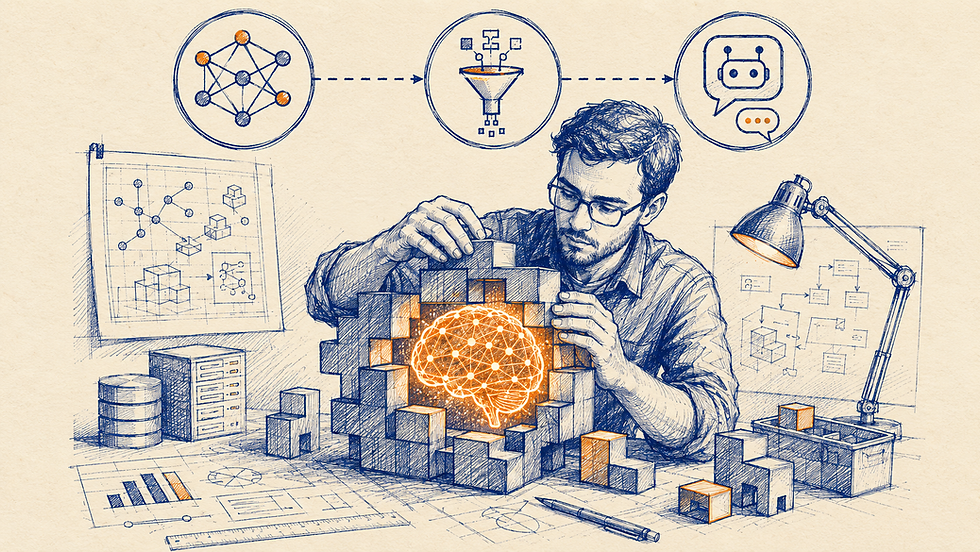
An AI development company designs, builds, and maintains artificial intelligence systems for other businesses- machine learning models, natural language tools, computer vision pipelines, or generative AI applications built around a client's own data and workflow, rather than off-the-shelf software.
Unlike a general software vendor, the work involves a layer most teams underestimate: data preparation, model selection and fine-tuning, evaluation against real-world edge cases, and monitoring after launch. A generalist agency can usually build the surrounding application; an AI/ML development company brings the specific expertise needed to make the AI component actually reliable.
The strongest partners combine three skill sets: software engineering to ship and maintain production systems, data science and ML engineering to build and validate models, and domain understanding of your industry so the solution solves the right problem in the first place.
Demand for outside help has grown for a simple reason: experienced ML engineers are expensive and hard to hire, and most businesses only need that expertise for a defined project rather than a permanent headcount line. Working with an established AI development company gives a team access to that skill set on a project basis, along with lessons already learned from prior builds- mistakes an in-house team would otherwise make (and pay for) for the first time.
Industries That Rely on an AI Development Company
AI adoption is no longer limited to tech-native companies. Common use cases include:
• E-commerce & retail- product recommendations, demand forecasting, and visual search.
• Financial services- fraud detection, document processing, and risk scoring.
• Healthcare- clinical documentation support, imaging analysis, and intake automation (with appropriate compliance review).
• Logistics & supply chain- route optimization, demand planning, and predictive maintenance.
• SaaS & B2B software- in-product AI features, support automation, and internal copilots for customer-facing teams.
The underlying techniques overlap across industries- the difference is usually the data available, the compliance requirements, and how much the workflow needs to change around the new system.
What Services Does an AI Development Company Provide?
A full-scope AI development company typically covers four layers of work: strategic advisory, custom software engineering, applied AI/ML, and the data infrastructure underneath it. Here's what each layer usually includes.
AI Strategy & Consulting
Before any code gets written, a good partner audits your data, systems, and business goals to determine whether AI actually solves the problem- and which approach fits your budget and timeline. Mpiric's AI consulting practice starts every engagement here, because a clear strategy prevents the most common failure: a technically impressive model nobody in the business ends up using. This stage typically also produces a rough cost and timeline estimate, so stakeholders can decide whether to proceed before deeper engineering spend begins.
Custom AI Software Development
This is the engineering work- APIs, pipelines, and the application layer that wraps a model so it's usable inside your existing product or internal tools. Custom AI software development covers everything from a recommendation engine bolted onto an e-commerce platform to a fraud-detection service inside a banking backend. It should follow the same code quality, testing, and security standards as any other production software, not a research prototype- including version control, automated testing, and a proper staging environment before anything reaches real users.
Generative AI, LLMs & AI Agents
Most current AI development work involves large language models in some form: a retrieval-augmented chatbot, a document-summarization tool, or an autonomous agent that can call internal APIs and complete multi-step tasks. Generative AI solutions range from a lightweight wrapper around an existing model to a fully custom-trained system, and AI agent development is quickly becoming its own specialty as businesses move from single-response chatbots to agents that plan and execute tasks with limited supervision. Custom LLM development sits at the more advanced end of this spectrum- fine-tuning or building a model tailored to a company's own data and tone rather than relying entirely on a general-purpose one.
Data Engineering, NLP & Computer Vision
Underneath all of it sits data: pipelines that clean and structure information, natural language processing for text-heavy use cases, and computer vision for anything image- or video-based. Weak data infrastructure is the single most common reason AI projects stall after the pilot phase, so this layer deserves as much planning attention as the model itself. Data annotation and labeling, in particular, is easy to underestimate- most supervised models need carefully labeled examples before they can learn to perform a task reliably.
How Does the AI Development Process Work?
Most engagements with an AI development company follow a similar arc, even though the specific tools and timeline shift by project.
1. Discovery & Strategy
The team maps your current data, systems, and success criteria, then scopes one specific use case rather than “AI” in the abstract. The output is a written plan with milestones, an expected cost range, and a defined way to measure whether the model actually works.
2. Data Assessment & Preparation
Models are only as good as the data behind them. This phase covers auditing what data exists, cleaning and labeling it where needed, and building the pipelines that will feed the model in production, not just during testing.
3. Model Development & Training
Engineers select or fine-tune a model, test it against real cases, and compare it to a simple baseline to confirm it's actually adding value. For most use cases this means adapting an existing foundation model rather than training one from scratch.
4. Integration & Deployment
The model gets wired into your real application, APIs, and infrastructure, with proper versioning, logging, and rollback options if something goes wrong in production.
5. Monitoring & Iteration
AI systems drift as real-world data changes. Ongoing monitoring catches accuracy drops early, and a good partner builds in a feedback loop so the model improves after launch instead of degrading quietly.
In-House vs Outsourced vs a Specialized AI Development Company
Before committing budget, most teams weigh three paths: hire an internal team, use freelancers or a generalist agency, or bring in a specialized AI development company. Each has a different cost and risk profile.
Factor | In-House Team | Freelancers / Generalist Agency | Specialized AI Development Company |
Time to start | Slow- hiring takes months | Fast | Fast |
AI/ML expertise depth | Varies, hard to hire for | Inconsistent | Consistently high |
Cost structure | High fixed cost (salaries, tooling) | Low upfront, variable quality | Scoped project or retainer pricing |
Production reliability | Depends on team maturity | Often prototype-only | Built for production from the start |
Best fit | AI as a permanent, core product function | Small, low-risk experiments | Most commercial projects with a real deadline and budget |
There's no universally right answer. A company planning to make AI a permanent part of its product may eventually want an internal team. But for a first build, a specific use case, or a team without existing ML infrastructure, working with an established AI development company is usually faster and lower-risk than hiring from scratch.
How Much Does It Cost to Work With an AI Development Company?
Cost depends on data readiness, model complexity, integration scope, and compliance requirements- so treat any figure as a planning guide, not a quote.
Project Type | Typical Scope | Approximate Cost Range* |
Proof of concept / MVP | One use case, one model, minimal integration | Lower five figures |
Custom AI feature | Model plus integration into an existing product | Mid five to low six figures |
Full AI/ML platform | Multiple models, custom infrastructure, ongoing MLOps | Six figures and up |
Enterprise AI transformation | Multiple systems, compliance needs, dedicated team | Six to seven figures, often phased |
*Ranges vary widely by data readiness, compliance requirements, and how much custom infrastructure is needed.
A few factors consistently move the number:
• Data readiness. Clean, labeled, accessible data costs far less to work with than data still scattered across systems.
• Build vs. adapt. Fine-tuning or wrapping an existing foundation model is cheaper than training a custom model from scratch.
• Integration depth. A standalone tool is cheaper than a model wired deeply into legacy infrastructure.
• Compliance and security. Regulated industries (finance, healthcare) add review and audit overhead.
• Post-launch support. Ongoing monitoring and retraining should be budgeted as a recurring cost, not a one-time fee.
How to Choose the Right AI Development Company
Choosing the right AI development company matters more than almost any other decision in the project, since a weak partner can burn months of runway on something that never ships. Look for these signals before you sign anything:
• Relevant track record. Ask for examples of similar projects- same industry or same type of AI problem- not just an impressive-looking portfolio. A partner who has solved a nearby problem before will spot risks earlier.
• Technical depth beyond prototypes. Ask how they handle model monitoring, retraining, and rollback in production, not only how they build the first version. Plenty of vendors can produce an impressive demo; fewer can keep it accurate six months later.
• Clear data and security practices. They should be able to explain exactly how your data is stored, who can access it, and how they handle compliance requirements relevant to your industry, ideally in writing before the contract is signed.
• Transparent, staged pricing. A credible partner scopes work in phases with defined deliverables, rather than one large, vague estimate that leaves room to expand scope indefinitely.
• Real communication during the build. You want regular check-ins and access to working software early, not a single reveal at the end of a multi-month engagement.
• A plan for what happens after launch. AI agent development and other advanced use cases especially need a maintenance plan, since these systems keep interacting with changing, real-world inputs after deployment and can quietly lose accuracy without monitoring.
Common Mistakes to Avoid When Hiring an AI Development Company
• Skipping the data audit. Teams that jump straight to model-building often discover mid-project that the data isn't usable as-is, which forces a costly detour back to data cleanup.
• Choosing on price alone. The cheapest bid is rarely the cheapest total cost once rework, delays, and a second vendor to fix the first attempt are counted.
• No plan for monitoring. A model that isn't watched after launch tends to degrade quietly as real-world data shifts, and the drop in accuracy is often only noticed once it has already affected customers or decisions.
• Treating AI as a one-off project. The best results come from treating an AI system as a product that keeps improving, not a deliverable that ships once and is declared finished.
• Ignoring security and compliance early. Retrofitting compliance after launch is far more expensive than designing for it from day one, particularly in regulated industries where a redesign can mean re-certification.
• Underestimating change management. Even a well-built model fails to deliver value if the team it's meant to help isn't trained on how to use it or trust its output.
Frequently Asked Questions
How long does it take to build an AI solution?
A focused proof of concept can take a few weeks. A production feature integrated into an existing product typically takes two to four months, and a full platform or enterprise rollout can run six months or longer, depending on data readiness and integration complexity.
Do I need my own data science team to work with an AI development company?
No. Most clients don't have one, which is the reason they hire a partner. A good AI development company brings its own data scientists, ML engineers, and software developers, and simply needs access to your data and domain knowledge.
What's the difference between AI consulting and AI development?
AI consulting focuses on strategy: deciding what to build, whether it's feasible, and how it should fit your business. AI development is the hands-on engineering work that builds, trains, and ships the actual system. Many companies offer both under one roof so the strategy and the build stay aligned.
Can an AI development company work with our existing tech stack?
In most cases, yes. AI components are typically built as services or APIs that integrate with your current application, database, and cloud infrastructure rather than requiring a full rebuild.
How do I measure ROI on an AI project?
Define the metric before the build starts- hours saved, error rate reduced, conversion lift, or cost avoided- and measure against a clear baseline. Projects scoped around a vague goal like “using AI” are far harder to evaluate than ones scoped around a specific, measurable outcome.
Is it better to use an off-the-shelf AI tool instead of custom development?
Off-the-shelf tools are faster and cheaper for generic, well-solved problems. Custom development makes more sense when your data, workflow, or competitive advantage is specific enough that a generic tool can't capture it well.
Conclusion
An AI development company earns its value by turning a promising idea into something that works reliably in production- not just in a demo. The partners worth hiring combine strategic thinking, solid software engineering, and honest data practices, and they stay involved after launch instead of disappearing once the first version ships. The framework above- services, process, cost, and selection criteria- should give you enough to scope a first conversation with confidence, whatever stage your project is at.
If you're scoping an AI project and want a partner who treats it that way, take a look at Mpiric Software's AI development company services to see how an initial engagement typically starts.


Email artificial intelligence can be particularly helpful when managing large subscriber lists. Automated workflows can support lead nurturing, re-engagement, and personalized follow-ups based on customer actions, giving marketing teams a more efficient way to manage communication without manually handling every interaction.